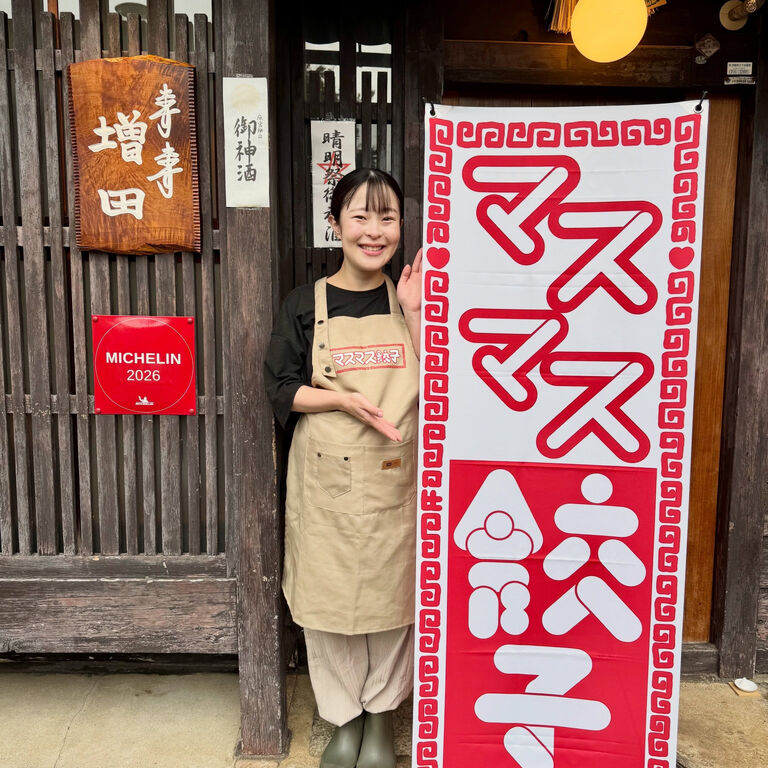
🥟マスマス餃子、いよい...
🥟マスマス餃子、いよいよ明日出店✨
大将がデザインした
「マ...
24.Oct.2026
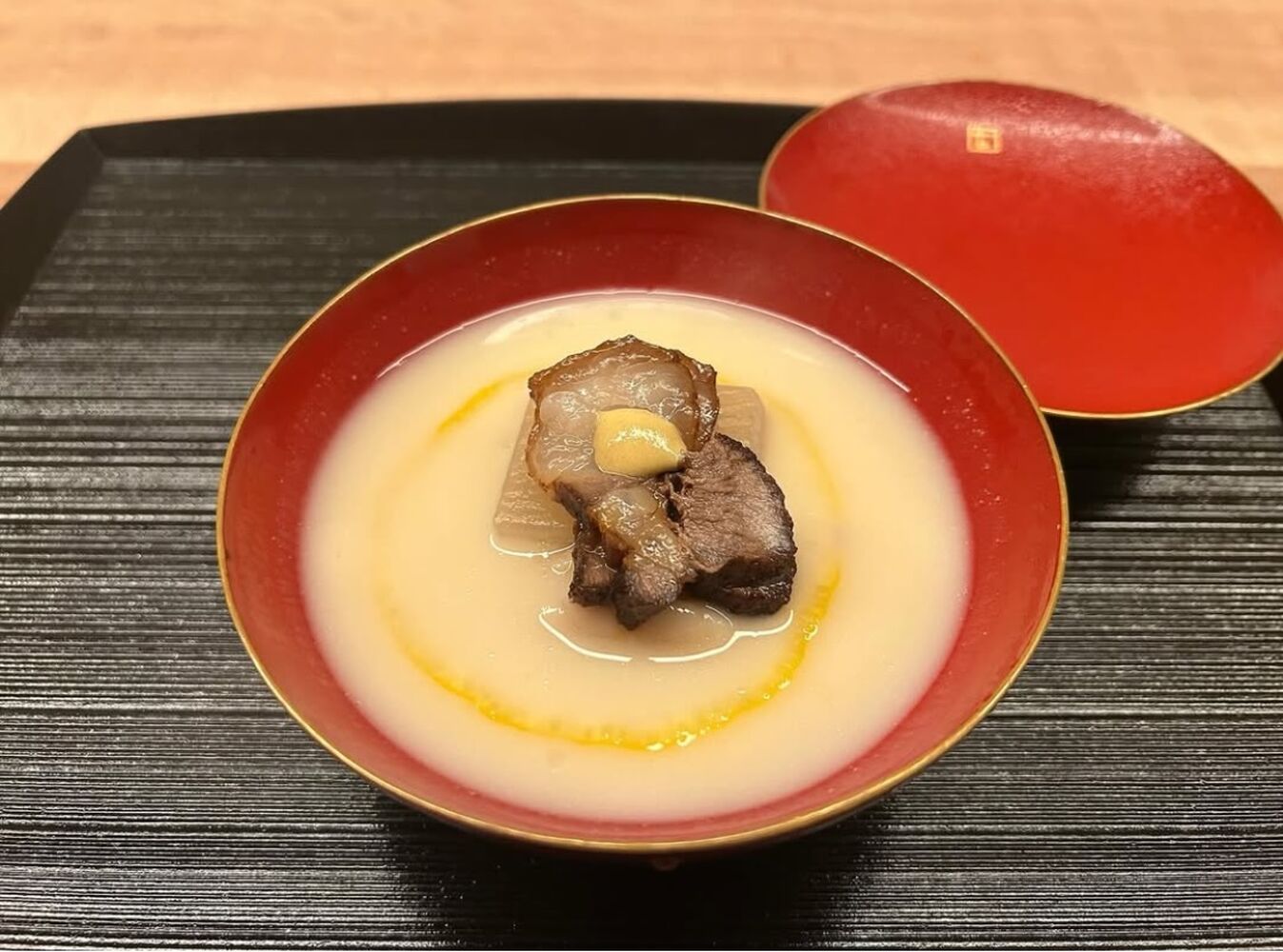
When talking about Kyoto cuisine, there is one type of miso that is particularly important:
white miso.
Beautifully pale in color, gently sweet, and rich with a soft, rounded depth of flavor, white miso has been an important part of Kyoto’s food culture for centuries.
It is perhaps best known for Kyoto-style New Year’s ozoni, a traditional soup enjoyed at the beginning of the year.
But white miso is much more than simply a “sweet miso.”
Why is it white?
Why is it sweet?
How does it differ from darker varieties of miso?
And why has white miso become so deeply associated with Kyoto cuisine?
At Masumasu Masuda, white miso also has a special meaning.
It is connected to the chef’s years of training in Kyoto and to a particular white miso that left a lasting impression on him.
This is the story behind Kyoto’s white miso culture and the seasonal white miso soup we serve at Masumasu Masuda.
目次
White miso is characterized by its pale white-to-cream color, gentle sweetness, and smooth, rounded richness.
One of the major differences between white miso and many darker types of miso is the high proportion of rice koji and relatively short maturation period used in its production.
Miso is made by fermenting ingredients such as soybeans and rice koji.
As fermentation and maturation progress, the color, aroma, and flavor of miso gradually change.
Generally, longer maturation produces a deeper color and more complex flavor.
White miso, however, is made to be enjoyed relatively early in its maturation, allowing it to retain its beautiful pale color and the gentle sweetness created by the abundant rice koji.
In other words, its pale color and sweetness are not simply because it has “not fermented.”
Rather, they are the result of a particular method of production, including the high proportion of koji and shorter maturation period.
When you taste white miso, the difference from a darker red or brown miso is immediately noticeable.
Rather than strong saltiness being the first impression, you may notice:
A soft sweetness.
A rounded richness.
A smooth texture.
And a gentle quality that seems to envelop the other ingredients in a dish.
Much of this characteristic sweetness comes from the rice koji.
Because white miso contains a high proportion of koji, the natural enzymatic activity of the koji produces sugars that contribute to its distinctive sweetness.
This allows white miso to do more than simply season a dish.
It can also add body, richness, and a gentle roundness to the entire dish.
Miso changes as it matures.
Over time, its color generally becomes darker, while its aroma, umami, and overall flavor become more complex.
A pale miso can develop toward deeper shades, eventually becoming increasingly reddish-brown depending on the ingredients and production method.
At the same time, the gentle sweetness characteristic of young white miso becomes accompanied by more pronounced fermented aromas, umami, and saltiness.
It is important to note that white miso does not simply become “red miso” if left to mature.
Different types of miso are produced using different ingredients, proportions, methods, and maturation periods.
However, the changing color and flavor of miso as it matures is one of the fascinating aspects of this traditional fermented food.
White miso has a particularly deep connection with Kyoto’s food culture.
It has historically been used in connection with the imperial court, temples and shrines, tea culture, celebrations, and other important occasions.
Perhaps the best-known example is:
Kyoto-style New Year’s ozoni.
In Kyoto, it is traditional to prepare ozoni with a white miso-based soup.
The sweetness of the white miso is combined with round mochi and seasonal ingredients such as daikon and carrot.
The white miso and round mochi have also been associated with ideas of purity, harmony, and good fortune at the beginning of a new year.
Through these traditions, white miso became deeply rooted in Kyoto’s culture of special and celebratory foods.
Another interesting preparation in Kyoto cuisine is fukusa-jiru.
Fukusa-jiru is a miso soup made by combining different types of miso, traditionally including white miso and red miso.
White miso brings sweetness and softness.
Red miso contributes stronger umami, saltiness, and a deeper fermented character.
By combining them, the chef can create a more complex and layered flavor than either miso might provide on its own.
The concept of combining different elements is an important part of Japanese culinary culture.
Rather than allowing one ingredient to dominate, different flavors are brought together to create harmony.
During his years of training at Kusakabe Nakahigashi in Kyoto, the chef encountered a white miso that left a particularly strong impression on him.
The restaurant used white miso from Shimamura Miso, located in the Demachiyanagi area of Kyoto.
The chef was deeply impressed by its character.
It was not simply sweet.
It had remarkably little unpleasant bitterness or astringency.
The flavor felt clean and clear.
At the same time, it had a beautiful richness.
Its texture and depth reminded him, in some ways, of the softness and richness of a delicate potage.
And then there was its beautiful white color.
This was the white miso that captured his attention and became part of his understanding of what truly good white miso could be.
At Kusakabe Nakahigashi, the chef experienced fukusa-jiru, in which white and red miso are combined to create a layered flavor.
At Masumasu Masuda, however, we chose not simply to reproduce that dish.
Instead, we wanted to allow the character of white miso itself to come forward.
For our seasonal soup, we use white miso as the central element.
But we do not simply dissolve white miso into stock and stop there.
The real work begins with the dashi.
We begin with dashi made from kombu kelp and dried bonito.
But we also look for additional sources of flavor within the vegetables used in the soup.
Depending on the ingredient, parts such as stems, trimmings, or other normally discarded portions may be lightly roasted first.
This helps draw out another layer of flavor from the vegetables themselves.
We then combine these flavors with the dashi.
The umami of bonito.
The depth of kombu.
The natural flavor of the seasonal vegetables.
And finally, the gentle sweetness and richness of white miso.
Rather than allowing one flavor to dominate, these elements are brought together into a single seasonal bowl.
A white miso soup should not simply taste like white miso.
One of the things we value most is allowing each vegetable to retain its own character.
Spring vegetables should taste like spring.
Summer vegetables should express summer.
Autumn vegetables should bring the feeling of autumn.
Winter vegetables should reflect winter.
We want guests to notice their individual aromas, sweetness, textures, and umami.
But if every ingredient simply speaks on its own, the soup will lack unity.
That is where the dashi becomes important.
The dashi connects the ingredients.
And finally, the gentle sweetness and richness of white miso wraps everything together.
What we want to create is not simply a soup that tastes of white miso.
We want to create a soup in which you can experience the season itself.
Taste a vegetable, and you should recognize its individual character.
Taste the broth, and you can discover the umami of bonito and kombu.
And then, as the flavors come together, the soft sweetness and richness of white miso remain gently in the background.
Each ingredient has its own identity.
Yet everything ultimately becomes one.
That is the style of white miso soup we aim to create at Masumasu Masuda.
White miso has a long history.
New Year’s celebrations.
Special occasions.
Temples and shrines.
Tea culture.
And Japanese cuisine.
It has been passed down through many different aspects of Kyoto’s food culture.
We do not believe that preserving tradition simply means reproducing an old dish exactly as it was made in the past.
What matters to us is understanding:
Why did people choose these flavors?
Why were these ingredients combined?
Why did this cooking method develop?
And then using that understanding to create food for people today.
That is how we hope to carry tradition forward.
At Masumasu Masuda, our omakase menu changes every month according to the season.
Our white miso soup also changes with the ingredients available at that time.
We select vegetables that are at their best and consider how their individual characteristics can work together.
The dashi is prepared with attention to the condition of the ingredients and the season.
And then comes the white miso.
Its beautiful pale color.
Its gentle sweetness.
Its rounded richness, which can sometimes feel almost like a delicate potage.
Together, these qualities envelop the seasonal vegetables.
For many people, white miso may simply mean “sweet miso.”
But good white miso has much more depth than sweetness alone.
Combined with dashi, it gains additional umami.
Combined with vegetables, it creates layers of natural sweetness.
Served warm as a Japanese soup, its softness and richness become even more apparent.
Perhaps this is one reason why white miso has remained so beloved in Japanese cuisine for generations.
When you visit Kyoto, we hope you will look beyond its temples, shrines, and historic streets and discover the city through its food culture as well.
Even something as simple as white miso connects many different aspects of Kyoto:
Fermentation.
History.
New Year traditions.
Celebration.
Temples and shrines.
Tea culture.
And Japanese cuisine.
A single bowl of soup can contain the history of a region as well as the feeling of a particular season.
That is one of the fascinating aspects of Japanese cuisine.
At Masumasu Masuda, our traditional Kyoto machiya restaurant in Nishijin offers a monthly changing omakase experience built around seasonal ingredients.
The chef’s years of training in Kyoto.
His encounter with exceptional white miso during his time at Kusakabe Nakahigashi.
And our desire to express Kyoto’s culinary culture through our own cooking.
All of these ideas come together in a single bowl.
Bonito and kombu dashi.
Seasonal vegetables.
Flavor drawn from the vegetables themselves.
And white miso.
Each ingredient retains its own character, while the gentle sweetness and richness of white miso bring everything together.
We hope you will experience Kyoto’s seasons in one bowl at Masumasu Masuda.
A taste of Kyoto, shaped by the season.
ますます増田
住所:京都府京都市上京区旧大宮通中立売上る庇町187−1