🥟🍺西陣オクトーバーフ...
🥟🍺西陣オクトーバーフェスト 🍺🥟
10月24日(土)・25日(日)...
19.Oct.2026
When people imagine Kyoto, they may picture temples, shrines, traditional gardens, and narrow historic streets.
But there is another important part of Kyoto’s cultural landscape that can easily be overlooked:
the Kyoto Machiya (京町家).
These traditional townhouses have long been part of everyday life in Kyoto.
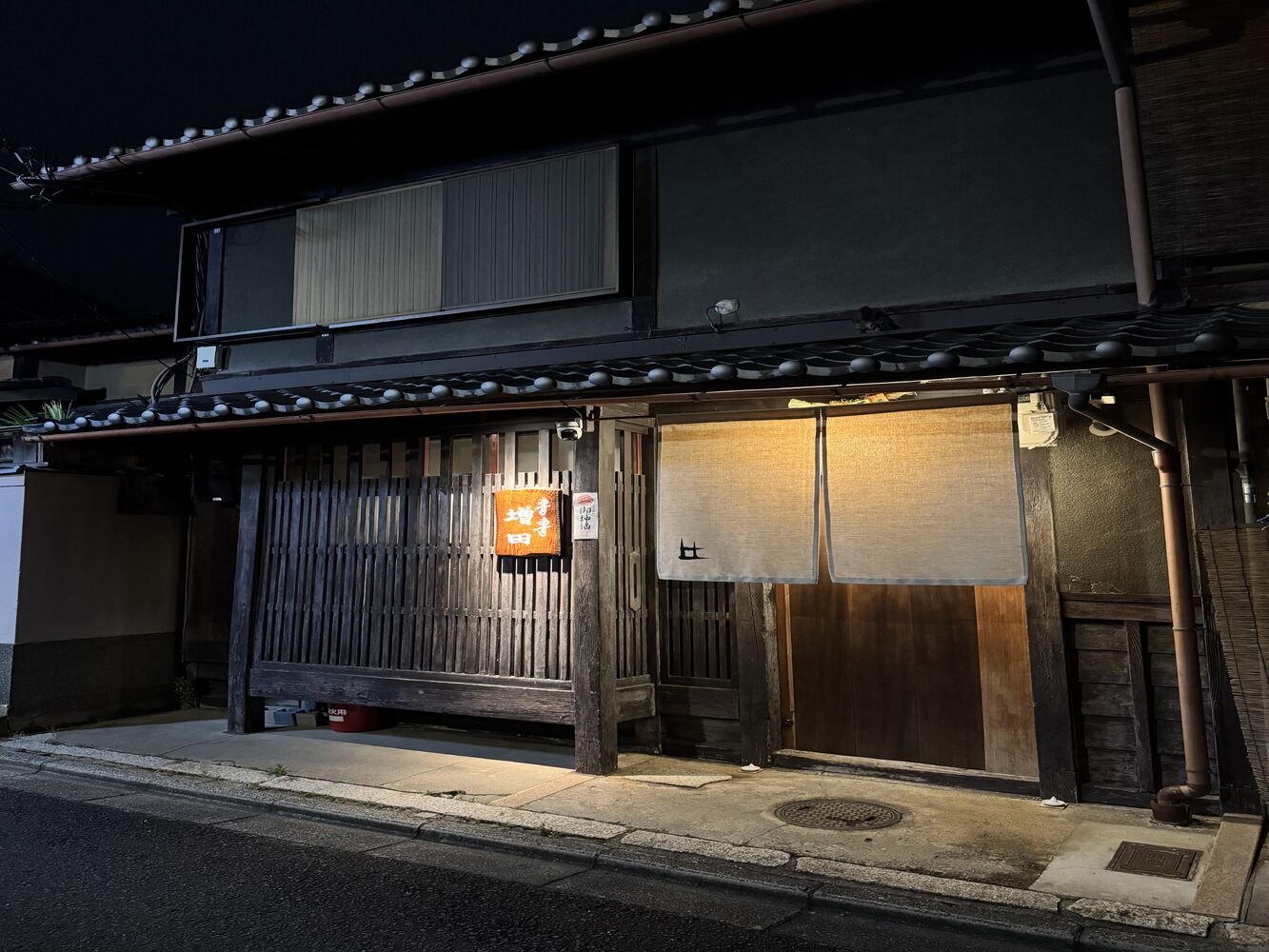
At Masumasu Masuda, our Japanese restaurant is located inside a Kyoto Machiya more than 100 years old, carefully renovated while retaining the atmosphere and character of the original building.
For us, the building itself is an important part of the dining experience.
You are not simply entering a Japanese restaurant.
You are entering a piece of Kyoto.
目次
A Machiya is a traditional urban townhouse found throughout historic Japanese cities.
Kyoto Machiya are particularly distinctive because they developed alongside the city’s unique urban culture and way of life.
Many traditional Machiya have a narrow frontage facing the street and extend deep into the property.
This distinctive layout was influenced by the historical structure of Kyoto’s city streets and the way properties were taxed and organized.
Inside, a Machiya may contain several interconnected spaces, including a shop or entrance area facing the street, living spaces, kitchens, storage areas, and often a small inner garden.
The result is a building that feels surprisingly deep despite its narrow appearance from the street.
One of the fascinating characteristics of a Machiya is that it was not originally designed simply as a residence.
Many Machiya were both homes and places of business.
Merchants and craftspeople could conduct their work toward the front of the property while living further inside.
This created a unique relationship between daily life, commerce, craftsmanship, and the street.
In areas such as Nishijin, this connection became particularly important because of Kyoto’s long history as a center of textile production.
Traditional buildings were therefore not simply beautiful architecture.
They were spaces in which people worked, lived, welcomed customers, and passed their skills from one generation to the next.
One of the most beautiful aspects of a traditional Machiya is its use of natural materials.
Wood.
Earth.
Stone.
Paper.
Clay.
Rather than covering everything with modern finishes, traditional architecture often allows the character of these materials to remain visible.
As the building ages, the wood becomes deeper in color.
Surfaces develop subtle marks.
The materials acquire a sense of history.
This is very different from the idea of beauty found in something that remains perfectly new.
In a Machiya, time itself becomes part of the architecture.
Masumasu Masuda is located in Nishijin, Kyoto, inside a Machiya that is more than 100 years old.
The building has been renovated for use as a Japanese restaurant, but we wanted to preserve the atmosphere and character of the original Machiya rather than transforming it into an entirely modern space.
The surrounding street is also lined with traditional Kyoto townhouses.
Walking through the neighborhood, you can still experience a quieter side of Kyoto away from some of the city’s busiest tourist areas.
Inside Masumasu Masuda, the atmosphere of the Machiya remains an important part of the experience.
A restaurant needs to function as a restaurant.
The kitchen needs to operate efficiently.
Guests need to be comfortable.
The space needs to meet modern standards.
At the same time, we wanted to preserve something that could easily be lost when an old building is renovated:
its sense of place.
We therefore designed the restaurant so that guests can enjoy Japanese cuisine while still feeling the character of the traditional Machiya around them.
The wooden structure.
The quiet atmosphere.
The proportions of the rooms.
The natural materials.
And the small garden.
Together, these create an experience that is very different from dining in a newly built restaurant.
One of the most special features of our Machiya is the tsuboniwa, or inner courtyard garden.
A tsuboniwa is a small garden incorporated into the architecture of a traditional Japanese building.
Despite its modest size, it can dramatically change the atmosphere of an interior.
At Masumasu Masuda, guests can enjoy the view of our garden from inside the restaurant.
The garden features carefully maintained moss, along with rocks and aged materials that complement the traditional architecture.
The greenery changes subtly with the seasons.
The color and texture of the moss.
The moisture after rain.
The light entering the garden.
The shadows cast by the surrounding wooden architecture.
Even within a small space, these details create a sense of depth and calm.
Traditional Japanese gardens are not necessarily about creating a large landscape.
Sometimes, a very small space can be enough to create a feeling of nature.
A tsuboniwa brings light, air, greenery, and the changing seasons into the center of the building.
For a traditional Machiya, where rooms may extend deeply away from the street, the inner garden also helps bring natural light and a sense of openness into the interior.
It creates a quiet connection between architecture and nature.
This is one reason why a small courtyard can have such a large influence on how a Machiya feels.
The garden at Masumasu Masuda is intentionally understated.
There is no need for dramatic decoration.
Instead, we appreciate the quiet beauty created by:
moss,
stone,
wood,
and
time.
The carefully maintained moss gives the garden a soft, almost velvety appearance.
The aged stones add weight and history.
The old wood of the Machiya provides warmth.
Together, these elements create a space that feels calm rather than extravagant.
This understated beauty is closely connected to traditional Japanese aesthetics.
At Masumasu Masuda, we want our guests to enjoy more than the food.
We hope you will notice the building.
Look at the wooden details.
Take a moment to look toward the tsuboniwa.
Notice how the light changes throughout the day.
Observe the texture of the old materials.
Listen to the quiet atmosphere of the Machiya.
These details are part of the experience.
The restaurant is a place to eat, but it is also a place where you can experience a small part of Kyoto’s architectural culture.
There is a natural connection between a traditional Machiya and Japanese cuisine.
Both place importance on seasonality, natural materials, restraint, and attention to detail.
The architecture changes with the seasons.
The garden changes with the seasons.
And the cuisine at Masumasu Masuda changes with the seasons as well.
The ingredients, dishes, presentation, tableware, and atmosphere all contribute to the feeling of the season.
This is why we believe the building should not simply be a background for the food.
The Machiya itself is part of the dining experience.
When you dine at Masumasu Masuda, we hope the experience goes beyond taste.
You may see the moss in the garden.
Feel the texture of the traditional wooden architecture.
Hear the quiet atmosphere of the Machiya.
Smell the seasonal dishes and charcoal cooking.
And taste the Japanese cuisine prepared by the chef.
These experiences come together naturally within the traditional architecture.
It is one of the reasons we chose a Machiya for Masumasu Masuda.
Nishijin is one of Kyoto’s historic neighborhoods, particularly famous for its connection to traditional textile culture.
The area retains many traditional streets and Machiya, creating an atmosphere that allows visitors to experience a different side of Kyoto.
Rather than simply visiting a historic building as a tourist attraction, you can actually spend time inside one.
Sit down.
Enjoy a seasonal Japanese meal.
Look toward the garden.
Talk with the chef and proprietress.
And allow yourself to slow down.
That is the experience we hope to offer.
Our Machiya has already lived through more than a century of Kyoto’s history.
The people who lived and worked here before us are part of the building’s past.
Today, we use the same space in a different way.
Instead of a traditional household or shop, it has become a Japanese restaurant.
But the building continues to welcome people.
Wood continues to age.
The garden continues to change.
And new memories are created here every day.
In that sense, the Machiya is not a museum.
It is a living part of Kyoto.
At Masumasu Masuda, you can enjoy a seasonal Japanese omakase meal inside a Kyoto Machiya more than 100 years old.
Surrounded by traditional townhouses in Nishijin, our restaurant offers a quiet atmosphere where the architecture, garden, cuisine, and hospitality come together.
Please take a moment during your visit to look at the tsuboniwa.
Notice the carefully maintained moss.
The aged stones.
The old wood.
And the way the garden and architecture frame one another.
We hope that while enjoying our Japanese cuisine, you will also feel something of the atmosphere of traditional Kyoto.
Not simply a meal in Kyoto, but a meal within Kyoto’s history.
That is one of the experiences we hope to share with you at Masumasu Masuda.
ますます増田
住所:京都府京都市上京区旧大宮通中立売上る庇町187−1