🥟🍺西陣オクトーバーフ...
🥟🍺西陣オクトーバーフェスト 🍺🥟
10月24日(土)・25日(日)...
19.Oct.2026
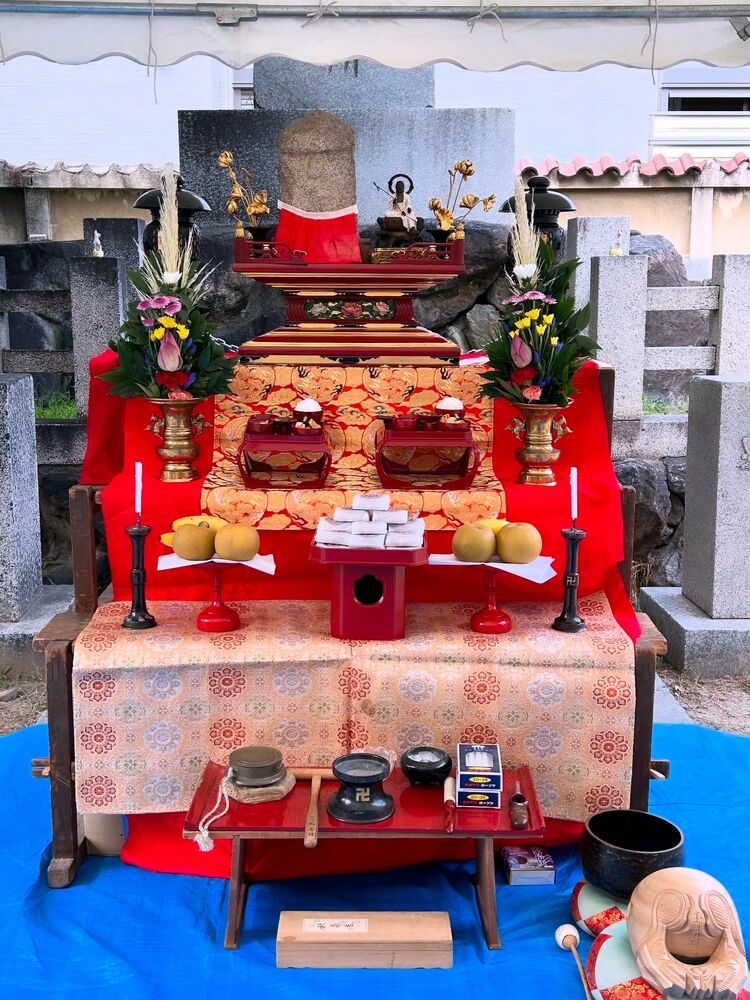
One of the traditions that marks the end of summer in Kyoto is Jizobon, a local Buddhist festival centered around Jizo Bodhisattva.
As you walk through Kyoto’s traditional neighborhoods, you may sometimes notice something unusual around a small Jizo statue that normally stands quietly by the roadside.
Lanterns and decorative curtains are placed around the statue.
The area is beautifully decorated.
Children gather and play.
Neighbors come together.
For a short time, an ordinary street corner becomes the center of the neighborhood.
This is Jizobon.
Unlike Kyoto’s famous festivals that attract visitors from around the world, Jizobon is primarily a community tradition.
It is part of everyday Kyoto life.
For us at Masumasu Masuda, a Japanese restaurant in Nishijin, this kind of quiet, living culture is particularly meaningful.
Kyoto is not only its temples, shrines, geiko and maiko, or famous festivals.
There are also countless small traditions that have been passed down within local communities for generations.
Jizobon is one of them.
目次
Jizobon is a traditional Buddhist community event held in honor of Jizo Bodhisattva, or Jizo Bosatsu in Japanese.
Jizo is widely believed to protect children and travelers, and has long been deeply connected to the everyday lives of local communities.
In Kyoto, Jizo statues can often be found at neighborhood corners and small roadside shrines.
These statues are not necessarily located inside large temples.
They can be found quietly within the neighborhoods themselves.
During Jizobon, local residents clean and decorate the Jizo shrine, hang lanterns, and gather together.
Children are often at the center of the celebrations.
Depending on the neighborhood, there may be sweets, games, raffles, Buddhist ceremonies, or other activities.
The exact customs and dates vary from one community to another.
Jizobon is generally held around late August, traditionally near the Buddhist observance of Jizo’s festival day.
One reason lies in the traditional structure of Kyoto’s neighborhoods.
For centuries, Kyoto’s people lived and worked within close-knit local communities.
Traditional Machiya townhouses often served not only as homes, but also as places of business.
Craftspeople, merchants, and their families lived close to one another.
People shared streets, worked together, watched over their neighborhoods, and helped one another in everyday life.
Within this environment, Jizo became an important spiritual presence in the community.
The small Jizo shrine at the corner of a street was not simply a religious object.
It was part of the neighborhood itself.
Jizobon therefore became more than a religious ceremony.
It became an opportunity for neighbors to meet, children to gather, and generations to spend time together.
One of the most distinctive aspects of Jizobon is the role of children.
Children may receive sweets, play games, participate in raffles, or take part in local activities.
For children, Jizobon can be one of the memorable events of summer vacation.
For adults, however, it also provides an opportunity to see the children of the neighborhood growing up.
In this sense, Jizobon reflects an important aspect of traditional Japanese community life:
children were not raised only by their parents, but were watched over by the wider community.
In today’s increasingly individualistic society, this kind of neighborhood connection is becoming less common.
That makes Jizobon even more precious.
Kyoto is famous for spectacular traditional events such as Gion Matsuri and Aoi Matsuri.
These festivals are internationally recognized and attract many visitors.
But Kyoto’s cultural heritage is not limited to these major events.
There are also much smaller traditions that have continued within individual neighborhoods.
A small Jizo statue at a street corner.
Lanterns at the end of summer.
Children’s voices echoing through a narrow street.
Neighbors gathering together.
These ordinary scenes may not appear in a typical travel guide.
Yet they are an important part of what makes Kyoto Kyoto.
They show us the city not as a tourist destination, but as a place where people actually live.
Masumasu Masuda is located in Nishijin, an area of Kyoto with a long history of textile production and traditional craftsmanship.
Nishijin became famous for its weaving culture, particularly Nishijin textiles.
For generations, craftspeople and merchants lived and worked in Machiya throughout the area.
A traditional Machiya was often connected to both family life and work.
People lived close to one another.
The street was not simply a road between buildings.
It was part of the community.
The neighborhood itself functioned almost like an extended family.
Jizobon is one of the traditions that reflects this historical way of living.
I, the proprietress of Masumasu Masuda, spent 14 years in Kyoto’s Gion Kobu district as a Maiko and Geiko.
The word “Geisha” is widely used outside Japan, but in Kyoto, professional women of this tradition are generally called Geiko, while apprentices are called Maiko.
During my years in the hanamachi, I learned about Kyoto’s traditional culture through daily practice.
Dance.
Shamisen.
Seasonal ceremonies.
Etiquette.
Language.
Hospitality.
And, above all, the importance of relationships and passing traditions from one generation to the next.
Traditional culture does not survive simply because its forms remain unchanged.
It survives because people continue to value it, practice it, and pass it on.
I feel the same spirit in Jizobon.
Jizobon is usually held in late August, when Kyoto is still warm but the season is gradually beginning to change.
The evenings become slightly shorter.
The quality of the breeze begins to change.
And the first hints of autumn slowly appear.
In Japan, seasonal transitions have traditionally been an important part of everyday life.
This sensitivity to the seasons is also deeply connected to Japanese cuisine.
Japanese cuisine is not simply about eating seasonal ingredients.
The season can also be expressed through:
Spring has its own flavors.
Summer has its own sense of freshness.
Autumn brings richer aromas and flavors.
Winter brings warmth and comfort.
A meal can make you think:
“It feels like the season has changed.”
That is one of the beautiful aspects of Japanese cuisine.
In this sense, experiencing Jizobon at the end of summer and experiencing the changing season through food are closely connected.
Both are ways of noticing the passage of time.
When visiting Kyoto, it is natural to want to see the famous temples, shrines, gardens, and historic districts.
But if you have the opportunity, we also encourage you to look at the quieter parts of the city.
A small Jizo statue at the end of a street.
A traditional Machiya.
Seasonal decorations.
A neighborhood festival.
Children playing outside.
People greeting their neighbors.
These everyday scenes reveal another side of Kyoto.
They show the culture that has continued not only in museums or historic buildings, but within people’s daily lives.
Masumasu Masuda is located in a traditional Kyoto Machiya that is more than 100 years old, in Nishijin.
Here, our chef prepares seasonal Japanese cuisine while I welcome our guests and share the hospitality and cultural knowledge I gained during my years in Kyoto’s Gion Kobu district.
We hope that our guests can experience more than simply a meal.
We want them to feel something of Kyoto through the food, the Machiya, the garden, the conversation, and the changing seasons.
Kyoto has many glamorous traditions.
Geiko and Maiko.
Gion Matsuri.
Tea ceremony.
Traditional crafts.
But there are also quiet traditions like Jizobon.
These small traditions, preserved by ordinary people in their neighborhoods, are an equally important part of Kyoto’s cultural heritage.
If you visit Kyoto during late August, keep an eye out for Jizobon.
You may notice a small Jizo shrine decorated with lanterns.
You may hear children playing nearby.
You may see local residents gathering together.
Please remember that Jizobon is a community tradition rather than a tourist attraction.
If you encounter one, observing quietly and respectfully is the best way to appreciate it.
It is a glimpse into a living Kyoto that has continued for generations.
At Masumasu Masuda, we create a new monthly omakase menu according to the season.
Late August is a particularly beautiful moment in Japanese cuisine.
Summer is not quite over.
Autumn has not fully arrived.
The ingredients, atmosphere, and flavors exist somewhere between the two seasons.
We use seasonal ingredients and Japanese culinary techniques to express that moment through our cuisine.
In our more than 100-year-old Machiya, you can enjoy the changing season while looking out toward our small courtyard garden.
Jizobon may seem like a small local festival.
But within it are many important aspects of Kyoto’s culture:
Community.
Family.
Children.
Faith.
The seasons.
And the responsibility of one generation to pass something on to the next.
These are also values that we cherish at Masumasu Masuda.
My experience in Kyoto’s hanamachi taught me the importance of preserving and passing down culture.
Our chef’s experience in Japanese cuisine taught us how food can also carry culture from one generation to another.
We hope to continue sharing both through our restaurant.
When you visit Kyoto, we hope you will look beyond the famous sights and discover the quieter traditions that continue in its neighborhoods.
See the temples.
Walk through the old streets.
Discover Nishijin.
Notice the small Jizo statues.
Feel the changing season.
And, when the day comes to an end, take time to enjoy seasonal Japanese cuisine in a traditional Kyoto Machiya.
At Masumasu Masuda, we hope to share not only the flavors of Kyoto, but also a small part of the culture and spirit that have been passed down through generations.
**Kyoto is not only a city to see.
It is a city to feel, to taste, and to experience through its people and its seasons.**
ますます増田
住所:京都府京都市上京区旧大宮通中立売上る庇町187−1