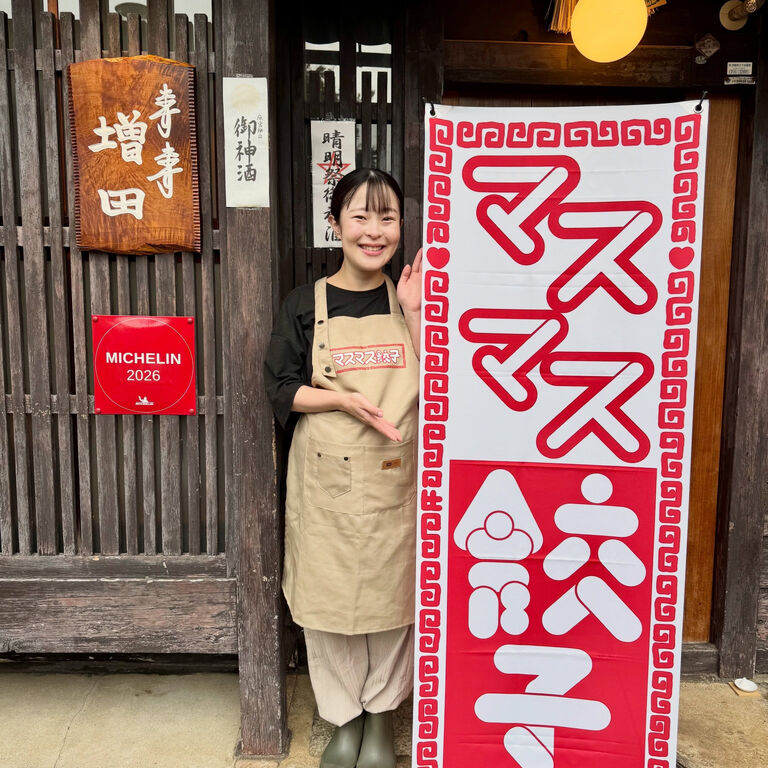
🥟マスマス餃子、いよい...
🥟マスマス餃子、いよいよ明日出店✨
大将がデザインした
「マ...
24.Oct.2026

October in Kyoto is the time when the heat of summer finally begins to fade and autumn becomes more noticeable.
The mornings and evenings become cooler, the air feels crisp, and the city gradually takes on a different atmosphere.
When people think of autumn in Kyoto, many may immediately think of the autumn leaves of November.
However, October is also one of the most fascinating seasons for experiencing Japanese cuisine.
Matsutake mushrooms.
Pacific saury.
Chestnuts.
Ginkgo nuts.
Mushrooms.
Persimmons.
And many other fish and vegetables that gradually become more abundant as autumn deepens.
October offers a special opportunity to experience the feeling of autumn becoming richer day by day.
For visitors traveling to Kyoto in October, we recommend looking beyond temples, shrines, and sightseeing and paying attention to the seasonal ingredients that appear in the markets and on restaurant menus.
From the perspective of a chef running a Japanese restaurant in Kyoto’s Nishijin and Imadegawa area, this article introduces ten seasonal ingredients to enjoy in October, along with some of the pleasures of experiencing autumn through Japanese cuisine.
目次
By October, autumn has begun to settle into Kyoto.
There can still be warm days during the daytime, but the mornings and evenings are noticeably cooler than in summer.
The sky seems higher.
The breeze changes.
The sun sets earlier.
And the ingredients appearing in the markets gradually become more distinctly autumnal.
September is a season of transition, when summer and autumn overlap.
October, however, is when autumn ingredients truly begin to come into their own.
Matsutake mushrooms.
Pacific saury.
Various mushrooms.
Chestnuts.
Ginkgo nuts.
Persimmons.
Taro.
And fish that gradually begin to develop richer flavors.
For a chef, this is an especially exciting time of year because the range of ingredients continues to expand.
When people think of autumn ingredients in Japan, matsutake mushrooms are often among the first that come to mind.
The greatest attraction of matsutake is its fragrance.
In Japanese cuisine, we pay attention not only to taste, but also to aroma, texture, temperature, tableware, and many other elements.
Matsutake is one of the ingredients through which the season can be experienced through fragrance.
The aroma released when matsutake is grilled.
The fragrance that rises when the lid of a soup bowl is opened.
The aroma of matsutake cooked with rice.
Even before taking the first bite, the fragrance can make you feel:
“Autumn has arrived.”
Matsutake is a wonderful example of an ingredient that allows us to experience a season through all five senses.
When talking about autumn flavors in Japan, Pacific saury is another ingredient that many people associate with the season.
It is often enjoyed simply grilled, but Japanese cuisine offers many other ways to prepare it.
Sushi.
Vinegar-marinated preparations.
Grilled dishes.
Seared preparations.
Fried dishes.
The best method depends on the condition of the fish.
Its fat content.
The texture of the flesh.
Its size.
All of these factors are considered when deciding how to prepare it.
That is why using saury in autumn is not simply a matter of saying,
“It is autumn, so we should serve saury.”
Instead, the important question is:
“What is this particular fish like today, and how can we bring out its best qualities?”
Understanding the condition of an ingredient and responding to it is an important part of a chef’s work.
Sweetfish, known as ayu in Japanese, is often thought of as a summer fish.
However, as autumn approaches, its character begins to change.
Later in the season, sweetfish enter their spawning period and may be referred to as ochi-ayu, or “descending sweetfish.”
Their flavor is different from the young sweetfish enjoyed during summer.
This is one of the fascinating aspects of Japanese cuisine.
We do not simply ask:
“What kind of fish is this?”
We also ask:
“What season is this fish experiencing right now?”
The same sweetfish can have different characteristics depending on the time of year.
Young sweetfish in spring.
Summer sweetfish.
Autumn sweetfish.
Each has its own appeal.
October is a wonderful time to experience these subtle changes in seasonal ingredients.
Sweet sea bream, known in Kyoto as guji, has long been an important fish in Kyoto cuisine.
It has delicate flesh, a refined sweetness, and beautiful scales.
Sweet sea bream can be prepared in many ways.
Grilled.
Served in soup.
Steamed.
Or prepared in ways that make use of its crisp, flavorful scales.
Its character can change significantly depending on how it is cooked.
In Kyoto-style Japanese cuisine, rather than overwhelming an ingredient with strong flavors, we often try to bring out what is already there.
With a delicate fish such as sweet sea bream, the quality of the dashi and the precision of the cooking can make a significant difference.
Its flavor may seem subtle at first.
But as you continue eating, its depth gradually becomes apparent.
That quiet elegance is one of the qualities we love about Kyoto cuisine.
When people hear the word bonito, many think of hatsugatsuo, or the first bonito of spring.
But autumn bonito offers a completely different pleasure.
As bonito migrate through the sea, they build up fat and develop a richer flavor.
While spring bonito is often associated with a lighter, cleaner taste, autumn bonito can offer a deeper richness from its increased fat content.
Of course, the condition of the fish varies depending on its origin and the exact timing of the season.
That is why chefs look carefully at the fish before deciding how to prepare it.
As sashimi.
Seared.
As sushi.
Or in another preparation.
The same ingredient can reveal a different character as the seasons change.
That is one of the great pleasures of Japanese cuisine.
By October, chestnuts become one of the ingredients that truly represent the season.
Their greatest appeal is their natural sweetness.
In Japanese cuisine, chestnuts can be enjoyed in many forms.
Chestnut rice.
Steamed dishes.
Savory preparations.
Desserts.
One of the simplest and most comforting combinations is freshly cooked rice with chestnuts.
Warm rice.
Tender, slightly sweet chestnuts.
A touch of salt.
There is nothing particularly complicated about it.
But that simplicity allows the natural flavor of the ingredients to shine.
Japanese cuisine has a long tradition of enjoying seasonal ingredients without unnecessarily complicating them.
Chestnuts are a wonderful example of this philosophy.
Ginkgo nuts are another ingredient that immediately evokes autumn in Japan.
Their beautiful yellow-green color.
Their distinctive aroma.
And their subtle bitterness.
Japanese cuisine places great importance on the colors of a dish as well as its taste.
Sometimes, simply adding a few ginkgo nuts can completely change the seasonal impression of a dish.
They may be used in:
Soup.
Rice dishes.
Steamed dishes.
Grilled dishes.
Japanese cuisine brings together taste, aroma, color, tableware, and seasonality within a single dish.
Ginkgo nuts are one of the ingredients that allow us to experience autumn visually as well as through taste.
As autumn deepens, many different types of mushrooms become available.
Matsutake is only one of them.
Maitake.
Shimeji.
Shiitake.
Nameko.
And many other varieties can appear in autumn cuisine.
One of the pleasures of mushrooms is that each variety has its own distinctive aroma, texture, and umami.
A chef may choose one mushroom for its fragrance.
Another for its texture.
Another for the depth of flavor it adds to dashi.
Autumn mushrooms bring depth and richness to Japanese cuisine.
They also allow us to experience the gifts of the mountains.
The fragrance of the forest.
The natural umami.
The texture of autumn.
These are all elements that can be expressed through a single dish.
As autumn arrives, seasonal changes can also be found among Japan’s fruits.
One of the most representative is the persimmon.
Persimmons offer:
Natural sweetness.
Distinctive texture.
Beautiful color.
They can be enjoyed simply as fruit, but they can also be incorporated into Japanese cuisine.
Served fresh.
Combined with a traditional shira-ae dressing.
Paired with vinegared ingredients.
Or used to add a gentle sweetness to a savory dish.
In Japanese cuisine, fruit is not limited to dessert.
It can also be used as part of a savory dish, adding natural sweetness, acidity, freshness, or color.
The vivid color of a persimmon also brings a distinctly autumnal feeling to the table.
One ingredient we especially recommend discovering in Kyoto during autumn and early winter is ebi-imo, a traditional Kyoto vegetable.
Ebi-imo is a variety of taro with a distinctive curved shape.
Its name literally means “shrimp taro,” referring to its appearance.
It has a smooth texture, gentle richness, and a refined flavor.
When simmered, ebi-imo absorbs dashi while retaining its own delicate character.
Vegetables are an essential part of Kyoto cuisine.
Japanese cuisine is not only about fish and meat.
Seasonal vegetables.
Traditional Kyoto vegetables.
Ingredients rooted in local food culture.
Experiencing these ingredients is also an important way to understand Kyoto’s culinary traditions.
In September, one of the most interesting aspects of Japanese cuisine is the overlap between summer and autumn.
By October, the ingredients become increasingly autumnal.
Matsutake.
Pacific saury.
Returning bonito.
Chestnuts.
Ginkgo nuts.
Mushrooms.
Persimmons.
Taro.
Ebi-imo.
The mountains.
The sea.
The fields.
Autumn brings together gifts from all of these places.
Japanese cuisine does not simply place these ingredients on a plate.
The order of the dishes.
Their temperatures.
The progression of flavors.
Aromas.
Textures.
All are carefully considered when creating an entire course.
From the first dish to the final one, we think about:
“How can we allow our guests to experience autumn through this meal?”
This is one of the pleasures of an omakase course.
October is also a wonderful time to explore Kyoto.
The intense summer heat has begun to fade, making it more comfortable to walk through the city.
Visit temples.
Explore traditional neighborhoods.
Walk through historic streets.
Discover Kyoto’s traditional architecture.
And simply enjoy the changing atmosphere of the city.
The peak autumn foliage season may still be some time away in many places.
But Kyoto before the leaves reach their peak has its own quiet beauty.
Before the city becomes especially busy with autumn tourism, October can be a wonderful time to experience Kyoto at a more relaxed pace.
Walk through Nishijin.
Explore the Imadegawa area.
Discover traditional machiya townhouses.
Walk along quiet streets and small lanes.
This is another way to experience Kyoto.
In Kyoto, seasonal changes have long been incorporated into everyday life.
Food.
Clothing.
Tableware.
Flowers.
Interior decoration.
Seasonal events.
As the season changes, the things around us gradually change as well.
Japanese cuisine is part of this culture.
The bitterness of spring.
The refreshing feeling of summer.
The harvest of autumn.
The warmth of winter.
Eating a dish and thinking:
“Autumn has arrived again.”
This may be one of the most beautiful aspects of Japanese cuisine.
When visiting Kyoto, we encourage you to pay attention not only to the sights, but also to the seasonal ingredients and traditions that can only be experienced at that particular time of year.
At Masumasu Masuda, a Japanese restaurant in Kyoto’s Nishijin and Imadegawa area, we offer a monthly changing omakase course.
Our chef visits the market and considers the ingredients available at that particular time before creating the menu.
October is a season when autumn ingredients become increasingly abundant.
Should we use matsutake?
How should a particular fish be prepared?
Which autumn vegetables should be incorporated into the course?
These decisions are made by looking carefully at the actual condition of the ingredients.
We do not simply decide:
“It is October, so this is what we serve.”
Instead, we look for the ingredients that are at their best at that moment and consider how to prepare each one so that its natural qualities can be expressed.
That is one of the attractions of an omakase experience.
Alongside seasonal ingredients from Kyoto and throughout Japan, we also incorporate ingredients from Tochigi Prefecture, the chef’s hometown.
Our aim is to create Japanese cuisine that reflects the season while allowing each ingredient to speak for itself.
For many visitors, exploring temples and shrines is an essential part of a trip to Kyoto.
But there are other ways to experience the city.
Walking through Kyoto’s historic neighborhoods.
Discovering the history of Nishijin.
Exploring the quieter streets of the Imadegawa area.
And, at the end of the day, enjoying a seasonal Japanese meal.
These moments can also become an important part of understanding Kyoto.
Through food, you may notice:
“Kyoto is changing from one season to another.”
The fragrance of matsutake.
The richness of Pacific saury.
The sweetness of chestnuts.
The color of ginkgo nuts.
The aroma of autumn mushrooms.
Seasonal ingredients are one of the most immediate ways to experience the changing seasons.
October in Kyoto is a time when the transition into autumn becomes increasingly clear.
The sky changes.
The breeze changes.
The scenery changes.
And the ingredients found in the markets change as well.
Matsutake.
Pacific saury.
Returning bonito.
Chestnuts.
Ginkgo nuts.
Mushrooms.
Persimmons.
Taro.
Ebi-imo.
Autumn brings an abundance of gifts from nature.
At Masumasu Masuda, located in Kyoto’s Nishijin and Imadegawa area, we serve seasonal Japanese cuisine in a machiya townhouse more than 100 years old.
We hope that our guests will experience more than the food itself.
The small moss garden.
The character of the old wooden materials.
The seasonal decorations.
The quiet atmosphere of the machiya.
And the conversations shared around the counter.
Together, these elements create a dining experience that reflects autumn in Kyoto.
If you are visiting Kyoto in October, we encourage you to look beyond sightseeing and discover the seasonal ingredients that can only be enjoyed at this time of year.
As autumn gradually deepens across Kyoto, we hope you will take the opportunity to experience the flavors of the season through Japanese cuisine.
If you visit the Nishijin and Imadegawa area, we would be delighted to welcome you to Masumasu Masuda and share a taste of Kyoto’s autumn with you.
ますます増田
住所:京都府京都市上京区旧大宮通中立売上る庇町187−1